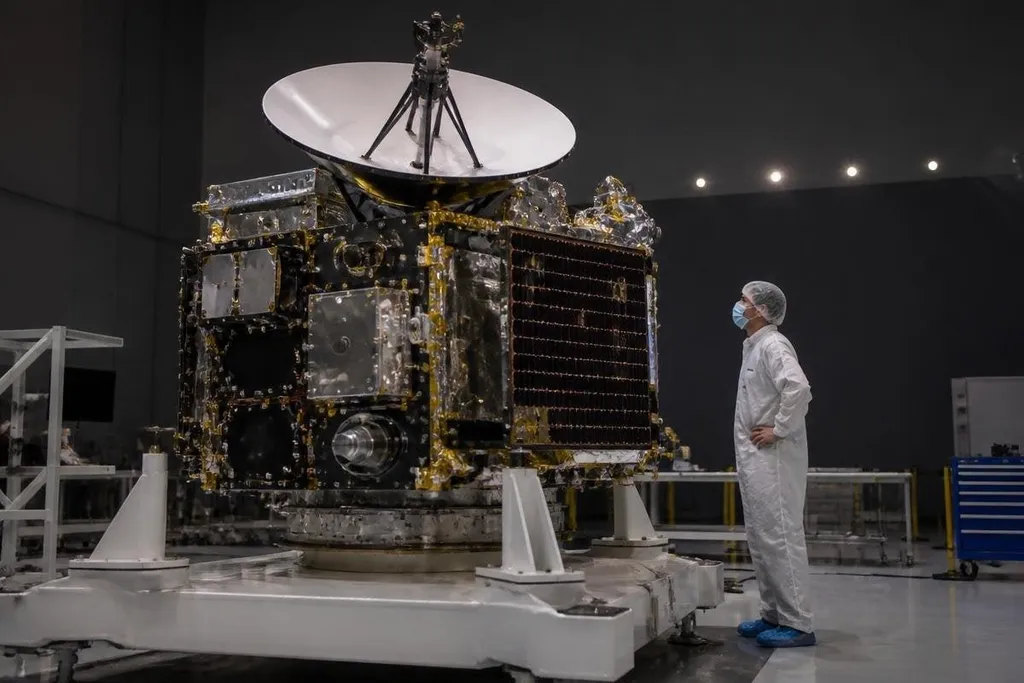
A human trip to another star would face long travel times, life-support demands, and radiation exposure. A robot could travel without food, sleep, or a return ticket, which makes robotic interstellar exploration the more practical first step.
- Robotic probes can work without air, water, or shelter.
- The main limits are travel time, power, communication, and repair.
- A useful mission may need to send data for years before anyone sees results.
Why robots fit the job
A robot does not need a cabin, exercise equipment, or protection designed for a human body. Mission planners could spend more of the spacecraft’s mass on power, sensors, communication hardware, and shielding.
That does not make the trip easy. A probe still needs to survive launch, operate after years in space, and keep its systems working far from Earth. It also has to send data across a distance where messages take years to arrive.
The distance changes the way engineers would control the mission. A nearby Mars rover can receive commands and send results within a time window that supports careful planning. An interstellar probe would need to handle many tasks on its own because a quick human reply would be impossible.
What the probe would need
An interstellar robot would need a clear job. It might measure dust between stars, study a target star system, or pass close enough to inspect a planet and its moons. Each task would shape the sensors, software, power system, and communications gear.
Speed would matter more than almost any feature. The nearest star system is more than four light-years away, so even a fast probe would spend many years in transit. A mission that sends a signal home after arrival would add another long wait before people receive the result.
Power creates a second hard limit. Solar panels become less useful as a spacecraft moves away from the Sun, so a probe would need another power source or a design built around very low energy use. The system would also need to keep heaters and electronics running through long periods of cold and darkness.
A probe between stars would operate far beyond direct control, so its software would need to detect faults and choose safe actions without a live command. A dated report from Robot 24 can put named robots and test results beside those mission claims.
Autonomy matters more than human-like form
Without a human body to support, the first interstellar robot probably would not need arms, legs, or a human shape. A compact spacecraft with sensors and a communication system could do more useful work than a humanoid body built for an environment with no floor, air, or tools.
Its software would need to spot faults, choose safe actions, and manage limited power. That could include changing the order of observations, shutting down damaged equipment, or waiting for better conditions near the target.
Repair would be harder. A probe cannot depend on a technician arriving with a spare part. Engineers would need backup systems, software that can isolate failures, and hardware that can keep working after years of radiation and temperature changes. Those safeguards add mass and make the design harder to test.
The limits are severe
A robot can remove the need to protect a human body, but it cannot remove the distance. Communication delays would prevent live control, and the mission could fail before the team on Earth learned what happened.
The target would also be difficult to study. A fast flyby gives the probe little time near another star system, while slowing down would require much more energy. A spacecraft that reaches the target but cannot stop may collect only a brief set of measurements.
There is also a gap between a small science probe and a machine that can build, repair, or reproduce itself.
That larger idea needs systems that can find raw material, make precise parts, manage power, and recover from unknown faults. No current public evidence shows that such a machine is ready for an interstellar mission.
A practical test for serious proposals
Use these checks when a company, lab, or space agency presents an interstellar robot concept:
- Name the target: Check which star system the mission would visit and how long the trip would take.
- Check the power plan: Ask how the probe will run sensors, heaters, computers, and its radio after leaving the Sun’s stronger light.
- Read the control plan: Look for tasks the robot can complete without quick commands from Earth.
- Find the repair answer: Check which failures the design can survive and which ones end the mission.
- Separate demo from flight hardware: A laboratory system may prove a useful function without proving long-duration space operation.
I’d treat self-repairing interstellar robots as a research goal, not a near-term plan. Smaller probes with narrow tasks make a clearer case because engineers can test each system against a defined mission.
The first robot to cross the space between stars may be small, slow to report, and built for one measurement. The open question is whether its power and communication systems can keep working long enough to tell us what it found.